A dated record of your voice · held in custody by AI Radio Malaysia
Can you prove your voice is yours?
It takes one short clip of audio to clone a voice. Your songs are already out there — which means your voice is too.
And when a clone appears, here is the hard truth: nobody can prove whose voice it copied. No software. No expert. No platform. The sound alone proves nothing — for anyone, anywhere.
Only one thing settles it: the date. The voice with the older record wins. Put your voice on file today, and anything that appears tomorrow answers to your record — not the other way around.
RM29, once. Because the one thing money cannot buy later is an earlier date.
Your recording stays private — never published, never played, never shared. Only you hold the receipt.
1. How it works
Upload one recording of your voice. The registry keeps it safe, records the date, and sends you a receipt by email. It is never published or played anywhere.
If anyone ever copies or clones your voice, this record proves your voice was on file first — with the date to show it.
RM29 for one recording.
2. What the filing records
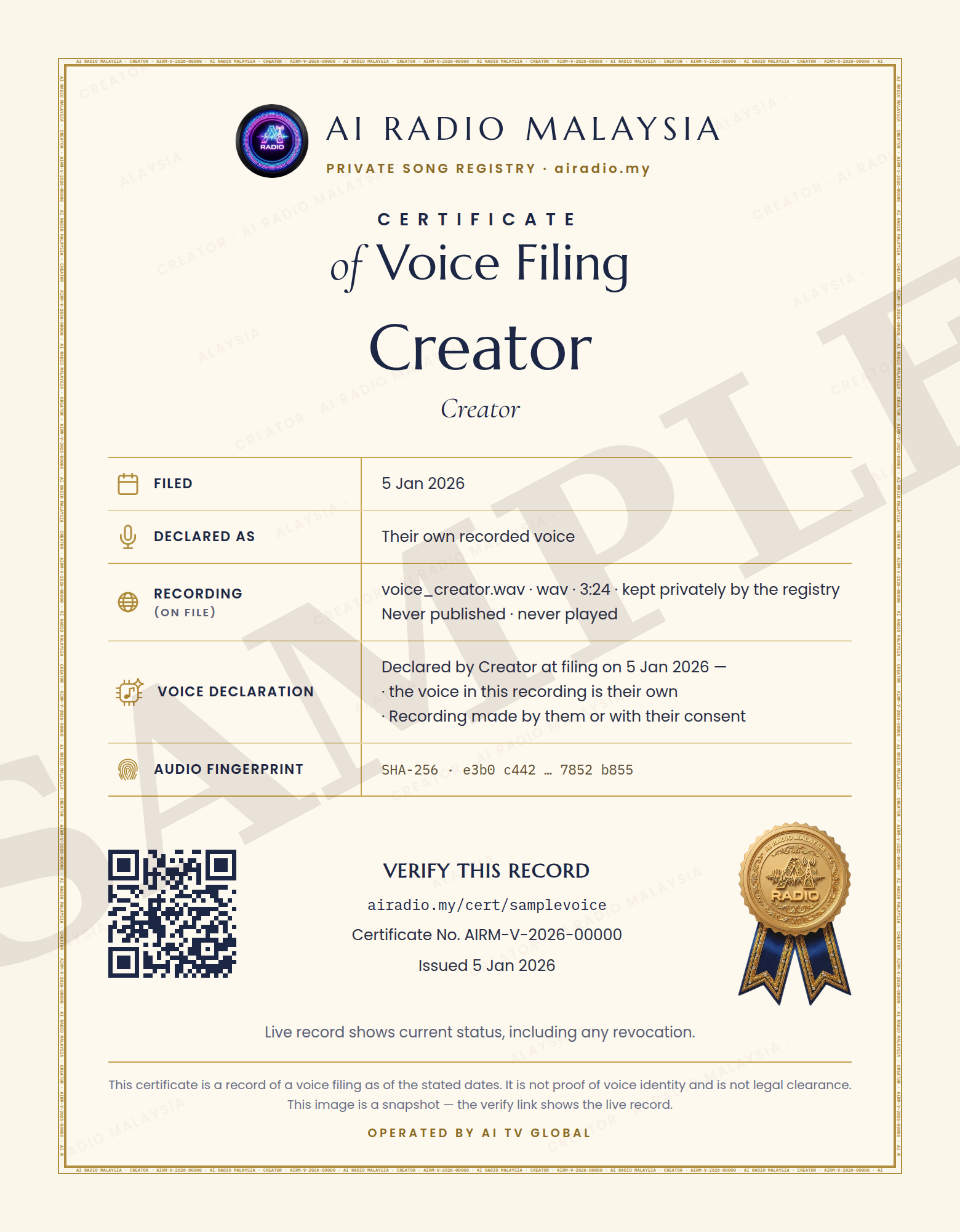
Filed
The date your recording entered the registry.
Declared as
Your own recorded voice, or the source recording behind a voice model trained on your voice.
Audio fingerprint
A unique fingerprint and integrity code computed from the recording itself. Any copy can be checked against it, byte for byte.
Custody
The recording is held privately by the registry, with an off-site backup. Never published, never played.
Receipt
A private email receipt with the date, the details, and your filing reference.
What it is not: the registry does not verify whose voice a recording is — no technology can. The filing records your declaration, your recording, and the date, under the registry’s published terms. A dated record beats no record.